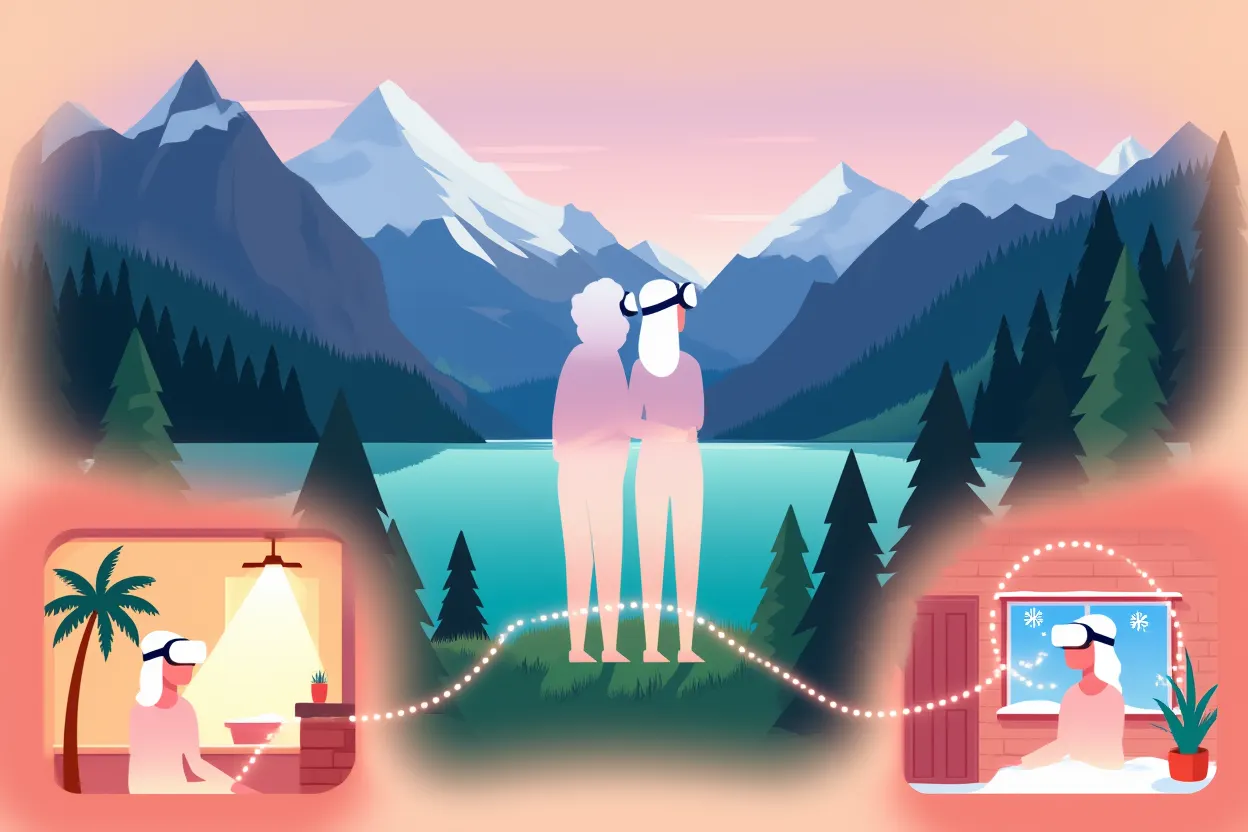
Picture this: A mother in Florida puts on a headset and finds herself standing in the Canadian Rockies she grew up. Her daughter, sitting in her apartment in Massachusetts, is right there beside her. Nope, they're not on a video call and they're not looking at photos. They're there together, looking around, remembering.
Hallucination? A scene from a science fiction movie? Neither. It's happening right now, in senior living communities and living rooms across the country.
And it might be one of the more surprising answers to one of the more serious problems facing older Americans today.
The problem isn't going away
Nearly one in three older adults in the United States still reports feeling socially isolated — a number that barely budged after the pandemic's peak. The health consequences are well-documented: increased risk of depression, dementia, heart disease, and early death. Researchers have compared the effects of chronic loneliness to smoking 15 cigarettes a day (take the test).
Technology has long been pitched as part of the solution. Smartphones. Video calls. Social media. And research does show that older adults who regularly use technology to communicate have richer, more active social lives than those who don't.
But there's a ceiling on what a FaceTime call can do.
"When older adults have easy, consistent ways to connect using technology, their social worlds expand," said Krissy Nappi, VP at Uniper, a company focused on technology designed for older adults and allows families to stay connected via TV, phone/tablet apps, and the internet.
"But access alone isn't enough. The experience has to be simple, reliable, and designed for how they actually live day to day."
For the Grams and Gramps around the world who don't have their face planted on their phone, virtual reality, its proponents argue, is better (much) than a smartphone because it clears that bar in a way that a two-inch face on a phone screen simply can't.
What VR actually feels like (in plain English)
Forget the word "metaverse." It conjures images of gaming teenagers and tech billionaires. For older adults, what VR actually delivers is something far more straightforward: the feeling of being somewhere, and more importantly, being there with someone. Can you say bye-bye, loneliness?
"Instead of just seeing each other on a screen, you're actually 'in' a virtual space together," said Kyle Rand, CEO and co-founder of Rendever, one of the leading VR platforms designed specifically for senior living communities.
"You can look around 360 degrees, move, and interact with your surroundings just like you would in the real world."
That shift — from watching to being — turns out to matter more than you'd expect or bargained for.
Are older adults in VR are more likely to actively lead the experience than they are on a video call? Yes, Rand says. They're pointing things out. Steering (without someone taking away their keys 😏). Not waiting for their grandchild to drive the conversation. That takes pressure off the relationship and opens the door to something different.
"Active reminiscence is much more likely in VR," he said, "and that has a host of therapeutic and relational benefits."
What can you actually do together?
VR possibilities are more than you'd think. Popular experiences include virtual travel – things that Me-Maw or Pops never got a chance to experience like safaris, hot air balloon rides, ocean dives, historic landmarks.
But the ones that resonate most aren't always the most exotic. They're personal. Revisiting a place that meant something. Going somewhere new that neither person has ever been.
"The very nature of doing something new together shifts the relationship and conversation in a positive direction," Rand said.
Beyond travel, seniors and families are also using VR for virtual meditation, painting, and trivia games.
FAQs: Practical questions about using VR
Do you need your own headset? For a shared immersive experience, yes — both people need one. A Meta Quest headset runs a few hundred dollars. If cost is a concern, check whether your senior living community already has VR equipment — Rendever alone is used in more than 700 communities nationwide.
Is setup complicated? Less than you'd expect. Most headsets involve connecting to Wi-Fi, adjusting the fit, and following on-screen prompts. Senior-focused platforms are designed to guide users through experiences step by step, with no complicated controls required.
What about glasses, limited mobility, or balance issues? Modern VR headsets are built to fit over glasses. Most senior-oriented VR experiences are designed to be done while seated, so standing or physical movement isn't required.
How long before it gets uncomfortable? Start short — five to ten minutes for a first session. Some people take to it immediately; others need a session or two to find their footing. Dizziness is possible, especially with fast-moving experiences. Stick to slower, more scenic content at first.
What about privacy — can strangers find you in VR? In closed, invitation-only environments, no — you interact only with people you've invited. But Rand flags a real caution for open VR spaces: if your Meta account is linked to a public Facebook or Instagram profile, other users could find and view it. Keep social accounts private.
Who should skip VR entirely? Anyone with epilepsy, severe vertigo, or significant heart concerns should check with a doctor first.
Does the research back this up?
Yes — though it's still early, and most studies so far have been conducted by companies with a stake in the outcome.
In a 2023 study with Vi Living, Rendever found that after eight weeks of regular VR use, 83% of seniors had expanded their social networks and were attending more community events. Sixty-seven percent showed measurable improvement in depression scores and quality of life.
Rand also noted that Rendever recently completed what he describes as the largest study yet on VR use for dementia and family caregiving — results are still being analyzed for publication.
Independent academic research is thinner but growing. A UGA study published earlier this year in the Journal of Applied Gerontology found that technology use broadly was strongly linked to more active social lives in adults over 65. VR is the leading edge of that same impulse: not replacing human connection, but making it feel more real.
 Smart Senior Daily Staff
The lowest risk first step
If you're curious but skeptical, Rand's suggestion is simple: start seated, start short, start with a family member in the room.
A five-minute virtual tour of a peaceful place — a quiet beach, a mountain overlook — is enough to get a feel for it without any pressure. You don't need to master anything. You just need to look around.
What you might find is that looking around together is the whole point.