
Special to Smart Senior Daily by Francine Toder, Ph.D. – Psychologist, Author, Writer, Consultant
The Takeaway
- At different life stages, your adult kids have different needs from you.
- When parenting an adult child, you no longer have authority.
- It's important to learn about your adult kid's values and life choices—without preaching.
- Your adult child can make choices and fail. You may be disappointed, but you are not responsible.
Why This Article Matters Now
Once upon a time there would have been no need for this article. Long ago parents did not need to figure out how to redesign a relationship with their adult-children. Life was predictably short, and survival into middle age or beyond was not something one could count on.
Understanding the process of growth and change in the young adult, the midlife adult, and the senior adult was not very significant to the average person. Yet here we are at a time when living to the age of 80,[1] and often beyond, is likely.
When Something Feels “Off” With Your Adult Kids
You may have a loving connection with your grown children but find that something is lacking. Rushed phone calls, or none at all, may be a clue. More obvious signs may take the form of anger or accusation.
Even though you’ve tried hard to understand and support your offspring, as adults, when you expected smooth sailing, you are finding a bumpy ride.
This Is Not an Extension of the Teen Years
This era is not an extension of their teen years, when defiance in search of autonomy was the name of the game. You may be familiar with the concepts of separation and individuation[2], a fundamental tenet of developmental psychology suggesting that these processes are age appropriate.
Losing Authority — and Feeling Shut Out
When they were teens you still had some authority in parenting—as tentative as that sometimes felt. Now, you may feel excluded or misconstrued. When you approach with advice, they bristle.
When you show concern for their problems, they say you’re intrusive. When you ask about their plans, they’re defensive. When you forget something, they’ve told you, it’s because you are insensitive and uncaring.
Different Decades, Different Needs
It is one kind of challenge when they are in their twenties, and are finding their wings, or searching for them. But a forty-something offspring has different needs.
And so it goes. As I write these words, I have kids aged 45 and 56 with whom I still continue to rework my relationship. And while you need to find distinctive strategies for effectively relating as the decades go by, there are a number of predictable scenarios that you’re likely to encounter along the way.
For this reason, I’ve created a tip sheet based on the situations I’ve detailed in my new book to offer some typical traps and ways to sidestep them.
Tips and Remedies
1. Until you really understand the problem, refrain from fixing it.
When your adult-child complains about a situation, they are likely venting to someone they can trust and who won’t judge them. It may make you feel uncomfortable, because what parent wants to see their kid, of any age, struggle and suffer. But it’s not your job to find a solution. Even worse, it might seem like you are undermining them and doubting their ability to handle their lives effectively.
2. Learn about your adult-kids’ values and life choices—no preaching.
As parents it’s natural to hope that our adult-kids turn out somewhat, or honestly, a lot like us. It’s flattering when they’ve adopted our way of life and ideals. But very often that does not happen. Society changes, the world turns, and ideas emerge that may be incompatible with your beliefs.
What to do? It’s too late for reiterating your principles. This strategy will be met with silence or resistance. It’s time to learn from them, what matters to them. That is, if you really want to understand and accept them as they are. Start by listening!
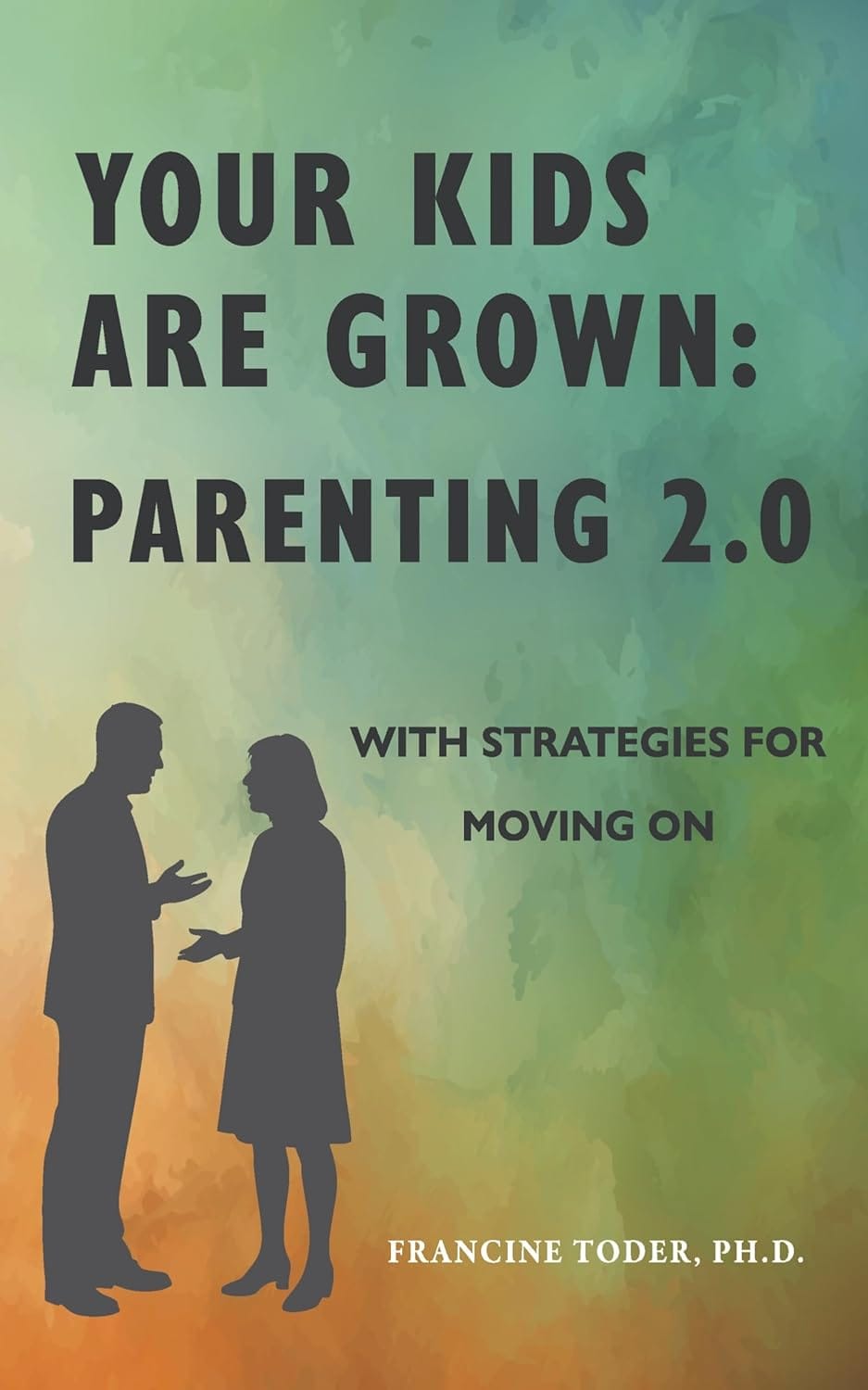
Your Kids are Grown: Parenting 2.0
Includes an extensive set of support materials and exercises for the reader to become more skilled in parenting adult-children
3. See your adult-child, not as you assumed him/her to be, not as you want him to be, but as he/she really is:
This is an extension from the above tip. Once again, they are not likely to follow in your footsteps. The path they take in life will zig and zag and probably detour along the way. They will have new ideas, different from you. Learn about them, from them. Become genuinely interested in finding out about who they are.
4. In conversation, if you’re talking more than 50 % then you are lecturing, not listening.
In the process of refining or enhancing your relationship with your adult-kid, let them take the lead. Try to sit back and take in what they have to say about life, love, and everything else. Try not to have the final word or be in a position of approving or negating. Try to relax into spectator mode and take in more than you may be comfortable with. Less is better in this case!
5. Paraphrase what you hear to get feedback on its accuracy:
This may sound like a phrase from a marriage counseling manual, but what works to improve a partner relationship also works in relationship to adult-children. It’s easy to distort what you hear when emotions run high so it’s best to check with the speaker which helps you interpret the message correctly.
This isn’t easy to do. We assume. We are often incorrect in our assumptions, which are colored by our own biases.
6. Your adult-child has the right to make choices and fail. You have the right to be disappointed, but not responsible:
This tip is self-explanatory. It’s easy to blame oneself. “I should have, could have . . .” won’t lead you anywhere healthy.
Many of us tried hard to do the right things in raising our children. Most of us did the best we could. We all make mistakes. But there’s always more to understand and learn in parenting adult-children. Begin your extended journey now.
The Relationship Keeps Evolving
Many of us tried hard to do the right things in raising our children. Most of us did the best we could. We all make mistakes. But there’s always more to understand and learn in parenting adult-children. Begin your extended journey now.