The Takeaway
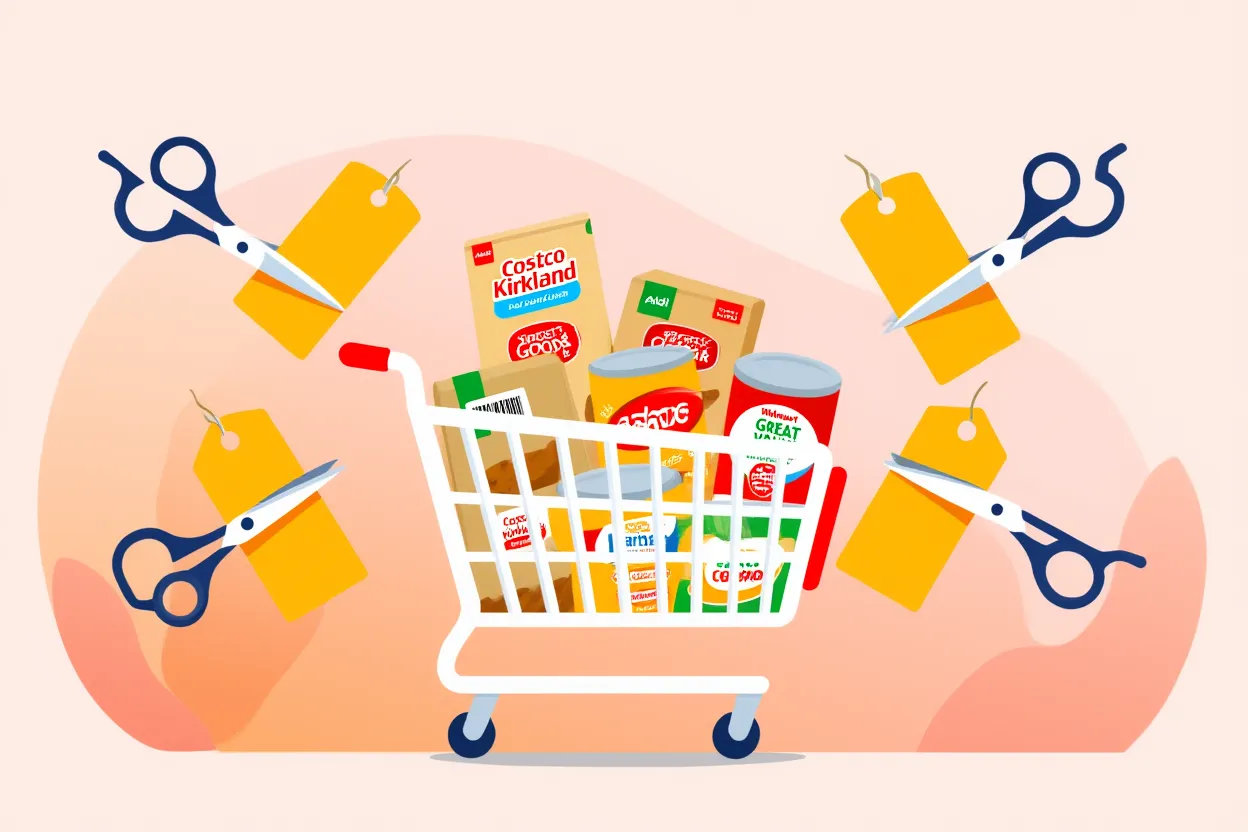
- Many store brands are manufactured by the same companies as national brands.
- Grocery savings average 30–45%.
- OTC medications often cost 60% less — with identical active ingredients.
- Warehouse alcohol can run 40–50% cheaper.
- A senior household can realistically save $480–$900 per year by switching strategically.
You’ve probably wondered.
Is that cheaper cereal really worse?
Is the store-brand ibuprofen weaker?
Or am I just paying for advertising?
Let’s pull back the curtain.
Because in aisle after aisle, the cheaper box often comes from the same factory as the expensive one.
The label changes.
The marketing budget changes.
The price changes.
But the manufacturing line often doesn’t.
And for seniors living on fixed incomes, that difference matters.
Who Actually Makes Store Brands?
Private-label products — that’s the industry term — are typically manufactured by one of three groups:
- The national brand itself (under contract).
- A major third-party manufacturer.
- The retailer’s own production facility.
Retailers don’t build factories for everything. They contract with companies already making similar products at scale.
That’s how:
- Kirkland batteries are manufactured by Duracell.
- Up & Up OTC medications are made by Perrigo.
- ALDI Millville cereal is made by General Mills.
- Trader Joe’s yogurt is made by Stonyfield.
- Safeway Signature pasta is manufactured by Barilla.
In many cases, you are paying 30–60% more for packaging and brand recognition.
The Data: Where the Biggest Savings Show Up
Let’s break it down by category.
1. Over-the-Counter Medications (The Heavyweight Champion)
If you buy just one category differently, make it this one.
Example:
Allergy tablets (365 count)
- Store brand: ~$14.99
- Claritin: ~$42.99
- Savings: 65%
Ibuprofen (200 count)
- Store brand: ~$4.29
- Advil: ~$11.99
- Savings: 64%
Here’s the key: under FDA regulations, generic OTC drugs must contain the same active ingredient, strength, dosage form, and route of administration as the brand-name product.
That’s not marketing language. That’s regulatory requirement.
For seniors managing arthritis, back pain, allergies, or sleep issues, this swap alone can save $200–$400 per year.
 Smart Senior Daily Staff
2. Pantry Staples
This is where compounding happens.
Cereal:
- ALDI Millville: ~$2.49
- Cinnamon Toast Crunch: ~$5.49
- Savings: 55%
Canned vegetables:
- Walmart Great Value: ~$0.68
- Del Monte: ~$1.48
- Savings: 54%
Pasta:
- Signature Select: ~$1.79
- Barilla: ~$2.79
- Savings: 36%
Pasta sauce:
- Whole Foods 365: ~$3.29
- Silver Palate: ~$6.49
- Savings: 49%
These aren’t tiny pennies. Multiply that across 40–60 grocery items per trip.
 Gary P Guthrie
3. Frozen and Refrigerated
Organic yogurt:
- Trader Joe’s: ~$4.49
- Stonyfield: ~$6.99
- Savings: 36%
Frozen meals:
- Trader Joe’s: ~$4.99
- Amy’s Kitchen: ~$7.49
- Savings: 33%
Ice cream:
- Signature Select: ~$4.49
- Blue Bell: ~$6.99
- Savings: 36%
For seniors who rely on convenient meals, this category adds up quickly.
4. Household Essentials
Laundry detergent:
- Kirkland (Henkel-made): ~$19.99
- Persil: ~$27.99
- Savings: 29%
Paper towels:
- Member’s Mark (Georgia-Pacific): ~$19.98
- Bounty: ~$27.98
- Savings: 29%
Bottled water:
- Great Value: ~$3.98
- Aquafina: ~$6.49
- Savings: 39%
These are recurring purchases. Even a 25% gap compounds.
 Smart Senior Daily Staff
5. Alcohol (Warehouse Clubs Are Disruptors)
Warehouse clubs quietly dominate here.
Vodka:
- Kirkland: ~$19.99
- Grey Goose: ~$34.99
- Savings: 43%
Scotch (Macallan-produced equivalent):
- Kirkland: ~$69.99
- Macallan 18: ~$149.99
- Savings: 50%+
Bourbon:
- Kirkland: ~$29.99
- Buffalo Trace: ~$39.99
- Savings: 25%
You’re often buying from the same distillery.
The difference? Marketing spend.
 Carolyn Ames
How to Identify Who Really Makes It
Want to play detective?
Two ways:
1. Factory Codes
On some products (like diapers), factory codes match between store and name brands.
2. UPC Prefix
The first 5–6 digits of a UPC code often identify the manufacturer. If they match between two products, that’s a strong clue they share origin.
This method isn’t perfect. But it’s surprisingly effective.
Why Are Store Brands Cheaper?
Three reasons:
- No national advertising budget
- Simpler packaging
- Retailer control over shelf placement
You are often paying for TV commercials when you buy the name brand.
Retailers don’t need to advertise their own label nationally. The shelf space is their marketing.
Do Store Brands Always Equal Name Brands?
No.
Sometimes formulations differ slightly.
Sometimes quality tiers vary.
Sometimes it’s a completely different manufacturer.
But in many high-volume categories — especially OTC drugs and staple groceries — the overlap is real.
And measurable.
The Math for Seniors
Let’s say a senior household switches strategically:
- 10 pantry items
- 3 OTC items
- 2 household staples
- 1 frozen meal category
Average savings per trip: $10–$18.
Per month: $40–$75.
Per year: $480–$900.
That’s not coupon clipping.
That’s brand indifference.
Where Seniors Should Focus First
If you want the biggest impact with the least risk:
- OTC medications
- Pantry staples
- Household paper goods
- Frozen meals
Alcohol? Optional. But lucrative.
The Psychological Barrier
Many seniors grew up believing:
“Name brand means better.”
Sometimes it does.
But sometimes it just means better marketing.
Private label has evolved dramatically over the past 20 years. Retailers now compete on quality, not just price.
 Gary P Guthrie
The Bottom Line
Store brands aren’t knockoffs anymore.
They’re often manufactured by the same companies.
The data shows consistent savings of:
- 30–45% on groceries
- 60%+ on OTC medications
- 25–35% on household goods
For seniors watching every dollar, this isn’t trivial.
It’s one of the simplest ways to protect retirement income without changing lifestyle.
And that’s rare.
Disclaimer: Prices reflect estimated 2026 national averages and vary by region and promotions. Manufacturing relationships can change over time. Always compare ingredient lists, active ingredients, and product specifications before purchasing. Smart Senior Daily does not receive compensation from the brands mentioned.