If you got a shot for measles when you were a kid, move on. If you didn't, then read on.
Measles is spreading a) quickly; b) far and wide:
a) There have been a few new outbreaks reported already in 2026. One of those is at the largest ICE child detention center (San Antonio) caused one physician to implore Texas to take "an immediate, unified command-and-control of the measles outbreak," emphasizing that “this is a public health emergency,” given workers who come and go from the facility can spread the disease.
b) On Friday, the South Carolina Department of Public Health reported 847 measles cases on Friday...including 58 additional infections since last Tuesday. Across the country, the CDC's count has confirmed measles cases in 17 states: Arizona, California, Florida, Georgia, Idaho, Kentucky, Minnesota, Nebraska, North Carolina, Ohio, Oregon, South Carolina, South Dakota, Utah, Virginia, Washington, and Wisconsin.
This isn't like if you were in the third grade
Measles still sounds like a childhood illness to a lot of people. You get a fever. A rash. A few days in bed. Mommy wipes your fevered brow. Daddy goes to the drugstore and buys you a comic book.
But for Seniors, measles can be a very different — and more serious — story.
Why seniors can still get measles
In the U.S., adults born before 1957 are generally assumed to be immune because measles was widespread before vaccines were common. Most people were exposed as kids and developed lifelong immunity.
But “generally immune” doesn’t mean “guaranteed.”
Some seniors never had measles. Others received only one early version of the vaccine, which didn’t always provide lasting protection. And immunity can matter more now than it did decades ago.
What measles looks like in adults
In seniors, measles often starts like a bad flu:
- High fever (often over 103°F)
- Cough, runny nose, sore throat
- Red, irritated eyes
- Fatigue that can be overwhelming
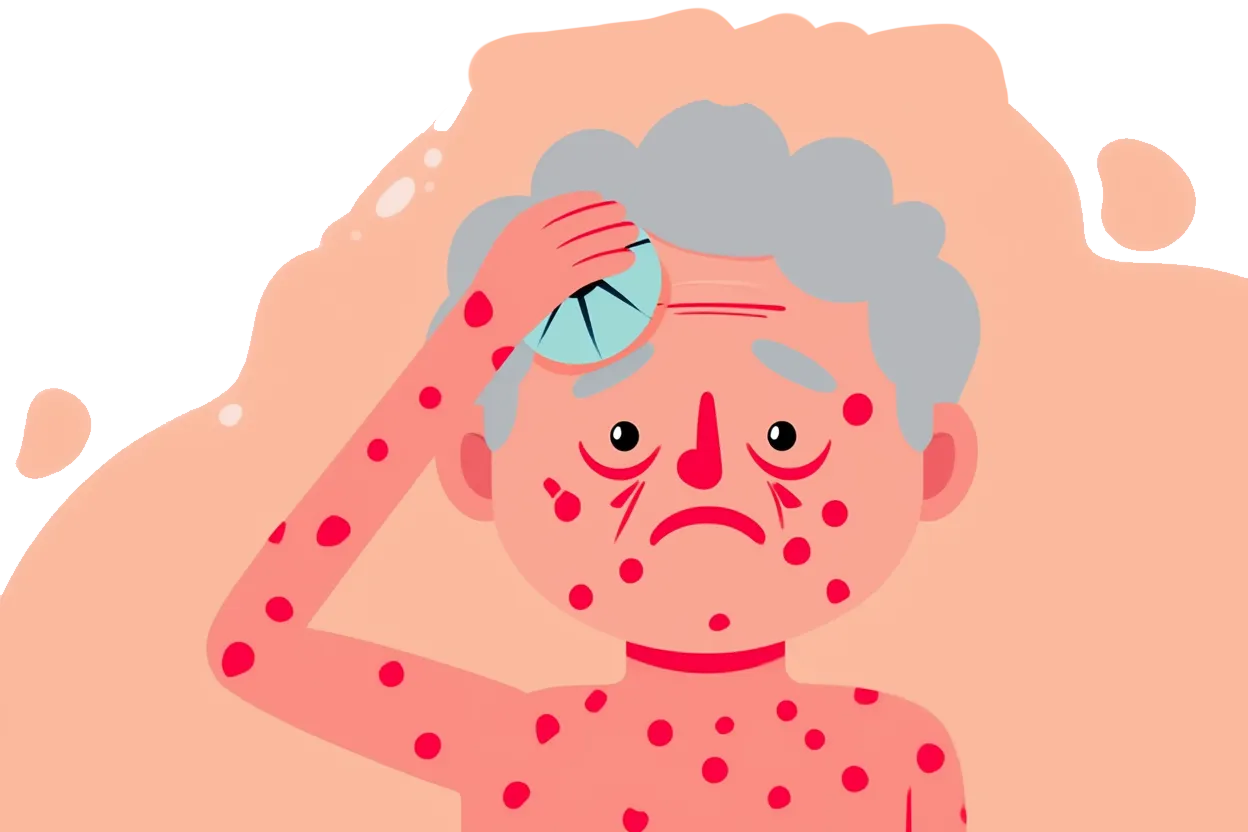
A few days later, a blotchy red rash spreads from the face downward.
But the rash isn’t the real danger
A rash is bad enough on its own, but older adults are far more likely than children to develop complications, including:
- Pneumonia
The most common serious complication for Seniors – life-threatening, especially for those with heart or lung disease. - Severe dehydration
Fever and poor intake can quickly spiral, leading to hospital care. - Hospitalization
Adults are hospitalized at much higher rates than children with measles. - Brain inflammation (encephalitis)
Rare, but serious. It can cause confusion, seizures, or long-term neurological damage. - Worsening of existing conditions
Diabetes, COPD, heart disease, and immune disorders can all be destabilized by measles.
This is why public health officials worry most about older adults and immunocompromised people during outbreaks.
How seniors can check their protection
You’re considered immune if any one of these is true:
- You have written proof of two MMR vaccinations
- A blood test shows measles antibodies
- A doctor confirms you had documented measles infection in the past
If you’re unsure, a blood test can usually answer the question quickly. And why not get one since Medicare will usually take care of the cost?
Use this as a quick self-check:
You’re likely protected if:
- You were born before 1957 and had measles as a child
- You have medical records showing two MMR shots
- A past blood test confirmed immunity
You should check with your doctor if:
- You don’t know whether you had measles
- You only had one measles vaccine
- You’re planning international travel
- There’s a measles outbreak in your area
- You have a weakened immune system
Call a doctor promptly if you develop:
- High fever plus cough and red eyes
- A spreading rash after flu-like symptoms
- Known exposure to someone with measles
A quick word on vaccination
The MMR vaccine is safe for most healthy adults, including many seniors who lack immunity.
However, it’s not recommended for people with severely weakened immune systems. That decision should always be made with a healthcare provider.
Health Disclaimer: This article is for informational purposes only and is not medical advice. Always consult your healthcare provider about vaccinations, immunity testing, or symptoms.