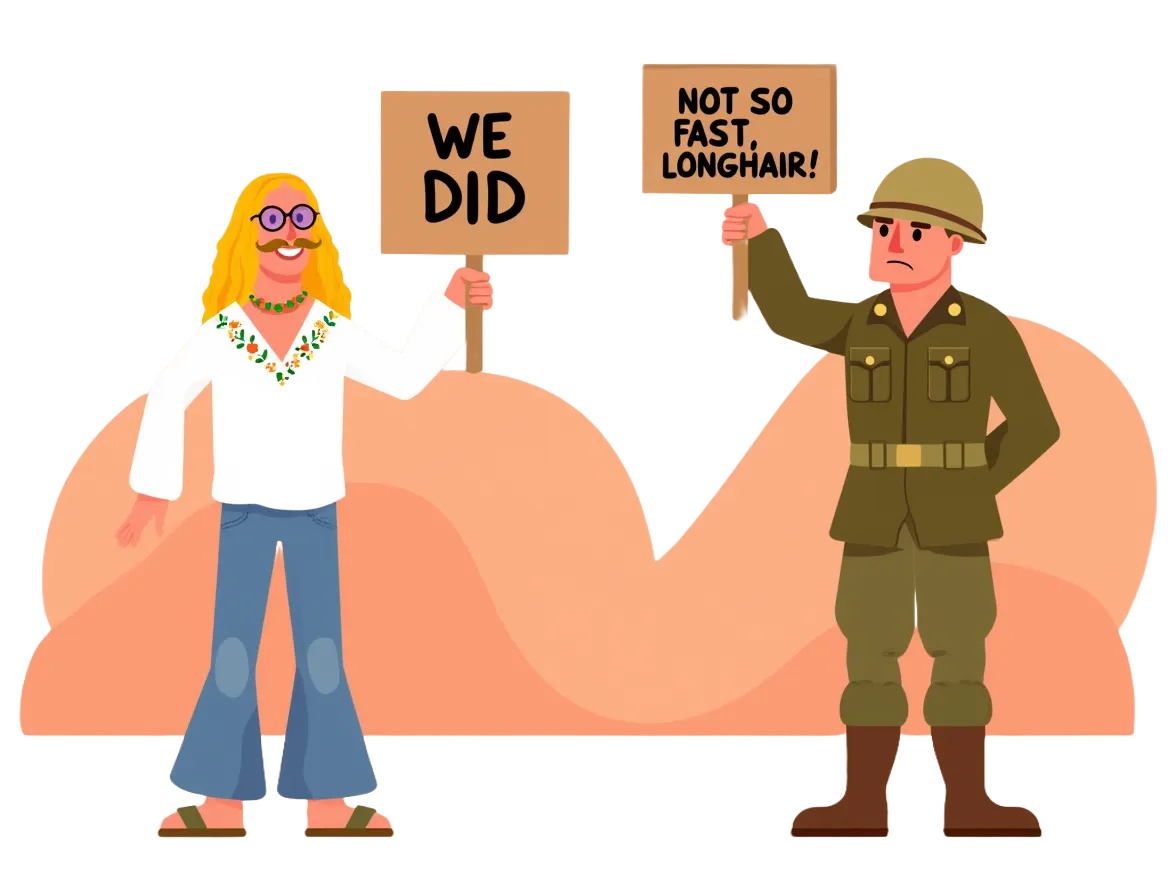
There's a story we've been telling for decades – one that pains me to write: Baby Boomers grew up, turned on, tuned in, and changed the world.
Rock and roll. Civil rights. Free love. The counterculture. The whole transformation of American life in the second half of the 20th century — Boomers did that.
Except they/we didn't. Not really.
Here's the inconvenient truth: most of the cultural earthquakes we credit to Boomers were already underway (or completely finished) before the oldest Boomer was old enough to vote. Sometimes before they were old enough to drive.
The people who actually lit the fuse were born a decade or more earlier, during the Great Depression and World War II.
They're called the Silent Generation — born roughly between 1928 and 1945. And they may be the most underrated generation in American history.
Who are the "Silents," anyway?
The Silent Generation gets its name from a 1951 Time magazine article that described them as cautious, conformist, and playing it safe in the shadow of their elders. The name stuck — and it's always been a little unfair.
Yes, they came of age during McCarthyism, when speaking out could get you blacklisted. Yes, they grew up in a world shaped by the Greatest Generation that preceded them and the massive Boomer wave that followed. They were demographically squeezed, politically overlooked, and culturally overshadowed.
But quiet? Not even close.
Rock and Roll? That was them.
Let's start with music, since Boomers love to claim it.
The oldest Baby Boomers were born in 1946. Rock and roll exploded in America in 1954 and 1955. That means the very first Boomers were about nine years old when the revolution started. They weren't making the music. They were buying bubble gum, Archie comics, and watching Howdy Doody.
The artists who invented rock and roll were Silent Generation, every single one of them:
- Chuck Berry — born 1926
- Little Richard — born 1932
- Elvis Presley — born 1935
- Buddy Holly — born 1936
- Jerry Lee Lewis — born 1935
- Fats Domino — born 1928
And then came the British Invasion in 1964, which set off the next wave of cultural upheaval. The Beatles? All four of them — John Lennon (1940), Paul McCartney (1942), George Harrison (1943), Ringo Starr (1940) — Silent Generation. The Rolling Stones' core members, same story.
Boomers didn't create rock and roll.* They inherited it. As teenagers and young adults, they became its most passionate audience and that audience mattered enormously. But there's a difference between creating something and consuming it enthusiastically. * (they did create Disco, tho' 😏)
Civil rights? That was them too.
This one is even more clear-cut.
The civil rights movement's most transformative years ran from roughly 1954 (Brown v. Board of Education) through 1965 (Voting Rights Act). The leaders who put their bodies and lives on the line to make it happen were almost entirely Silent Generation — or older.
- Martin Luther King Jr. — born 1929
- John Lewis — born 1940
- Medgar Evers — born 1925
- Julian Bond — born 1940
Rosa Parks, who refused to give up her seat on that Montgomery bus in 1955, was born in 1913? Greatest Generation. Thurgood Marshall, who argued Brown v. Board before the Supreme Court, was born in 1908.
The March on Washington was 1963. The The generation that actually changed America doesn't get nearly enough credit were 1961. The Montgomery Bus Boycott was 1955. The oldest Boomer was 17 in 1963. The youngest were still in diapers during the Freedom Rides.
The arts? Decades ahead of Boomers.
Abstract Expressionism — the radical movement that made New York the center of the art world and shattered every previous notion of what painting could be — was already a mature movement before the first Boomer drew a breath.
Jackson Pollock (born 1912), Willem de Kooning (born 1904), and Mark Rothko (born 1903) were doing their most revolutionary work in the late 1940s and early 1950s. Their younger peers — Robert Rauschenberg (born 1925), Jasper Johns (born 1930) — were Silent Generation artists who then dismantled Abstract Expressionism itself and invented something new.
The Beat Generation, which laid the cultural groundwork for everything that followed — the suspicion of authority, the embrace of nonconformity, the hunger for authentic experience over suburban comfort — was also Silent Gen through and through.
- Jack Kerouac — born 1922, published On the Road in 1957
- Allen Ginsberg — born 1926, published Howl in 1956
- William S. Burroughs — born 1914
On the Road came out in 1957. The oldest Boomer was 11 years old and probably didn't know how to even type.
Even feminism's second wave started there
Betty Friedan was born in 1921. Her book The Feminine Mystique, which many historians credit with igniting second-wave feminism, was published in 1963. Gloria Steinem was born in 1934.
The intellectual foundation of modern feminism was built by women of the Silent Generation and the generation before them — not by Boomers, who came along later to march in the streets those pioneers helped build.
So what did Boomers actually do?
If you're a Boomer and think you need a stiff drink after reading those preceding facts, put down the bottle because we need to be fair. Boomers weren't just passive bystanders.
There's a real difference between inventing a cultural movement and scaling it. And Boomers were extraordinary at scale. They were the largest generation in American history up to that point, some 76 million strong. When they moved through a cultural moment, they moved through it like a wave.
Woodstock (1969) drew hundreds of thousands of young Boomers. Vietnam War protests mobilized a generation. The sexual revolution spread from a handful of intellectuals and artists to an entire society, in large part because Boomers were there in massive numbers to carry it forward.
They also had staying power. Boomers dominated American politics, media, business, and culture for roughly 40 years. Their sheer size and longevity meant they got to write a lot of the history — including, perhaps, a version of the 1960s that gave them more credit than the timeline strictly supports.
Why does this matter?
If you were born between 1928 and 1945, you may have spent a lifetime watching a younger generation claim credit for your revolution. If you're a Boomer, you may be reading this with some defensiveness or clicked off by now.
And if you're simply someone who cares about getting history right, there's a lesson here about how cultural memory works. The biggest generation doesn't necessarily get to be the most important generation. Sometimes the people who change everything are the ones who slip through the cracks of the history books.
The Silent Generation invented rock and roll. Led the civil rights movement. Wrote the beats. Rewrote the art world. Planted the seeds of modern feminism.
They just didn't get around to bragging about it. If you're a Boomer, give them their due cred and be happy with the rather sizeable lot we were blessed with.