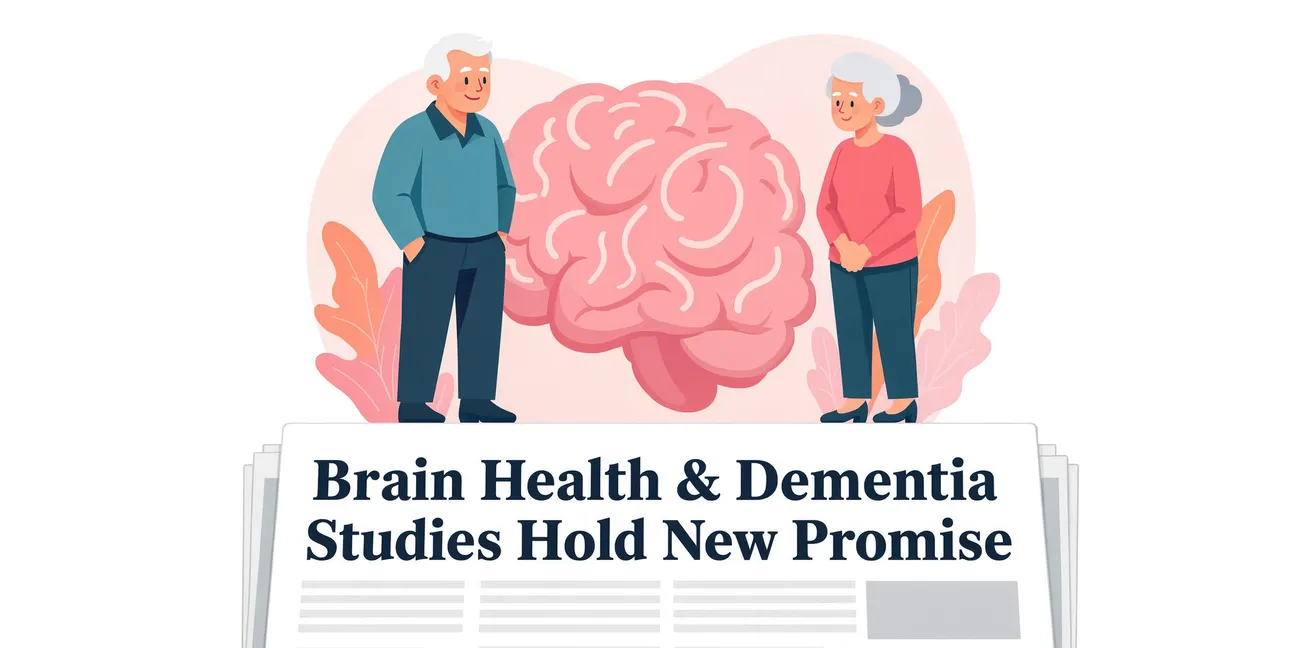
The MIND diet just got its strongest evidence yet. A Harvard Health-covered study, recently published in the Journal of Neurology, Neurosurgery & Psychiatry, followed 1,647 adults (average age 61) for roughly 12 years and found that closely following the diet was linked to 20% less grey-matter shrinkage—the equivalent of brains that looked 2.5 years younger than their actual age.
Every three-point jump in MIND-diet adherence tracked with that slower shrinkage, plus less enlargement of the brain's fluid-filled ventricles, another marker of aging.
The diet itself is simple: lean into leafy greens, berries, nuts, beans, whole grains, fish, poultry, olive oil, and a little wine; go light on red meat, butter, cheese, pastries, and fried food (backing off processed foods is a given). The CNN writeup gives some helpful context, though it’s worth noting that researchers still aren’t sure if the structural changes mean sharper day-to-day thinking.
 Smart Senior Daily Staff
The Pipeline is Getting Crowded on the Drug Side
If the number of studies is any indication, scientists are working overtime to try and rein in dementia and Alzheimer's. Here's three examples:
1️⃣ A recent ScienceDaily report highlighted newly identified USC research into a previously unrecognized trigger for Alzheimer's progression as well as a compound designed to block it—early-stage work, but a genuinely new angle on the disease.
2️⃣ Meanwhile, a team at ETH Zurich, after nearly two decades of research, unveiled “Compound 10” which stops a protein called GRK2 from clumping inside neurons.
In mice, it slowed nerve cell loss and reduced Alzheimer's-related damage through a pathway no existing Alzheimer's drug touches—meaning it could eventually be paired with current treatments rather than compete with them.
3️⃣ Then there's semaglutide, the compound behind Ozempic and Wegovy, which is opening up an unexpected new front. A UC San Diego–led trial reported June 11 gave the first randomized, placebo-controlled evidence that semaglutide can slow biological aging, as measured by epigenetic clocks.
That tracks with a JAMA Network Open study of over 60,000 adults with type 2 diabetes and obesity, which found GLP-1 drugs linked to significantly lower rates of dementia, stroke, and death versus other diabetes medications—real-world evidence a British Journal of Clinical Pharmacology review says keeps stacking up.
The catch: that protective effect looks strongest as prevention, before disease takes hold. Large trials testing semaglutide against Alzheimer's already in progress haven't shown the same benefit yet. Which is arguably the more hopeful read: this points toward heading Alzheimer's off before it starts, and semaglutide is just one of a widening pipeline of oral medications and non-drug approaches that BrightFocus Foundation says is expanding beyond the amyloid-focused treatments already approved.
 Smart Senior Daily Staff
Sources:
- MIND diet may slow age-related brain changes – Harvard Health
- Brain aging slowed by over 2 years with unique diet – CNN
- Scientists found a new Alzheimer's trigger and a drug that stops it – ScienceDaily
- New drug could slow the development of Alzheimer's – ETH Zurich
- New study shows popular GLP-1 weight loss drug may slow biological aging – University of California
- Weight loss drug does not slow Alzheimer's, says drug maker – Alzheimer's Research UK
Skip all approvals is on. Claude never pauses