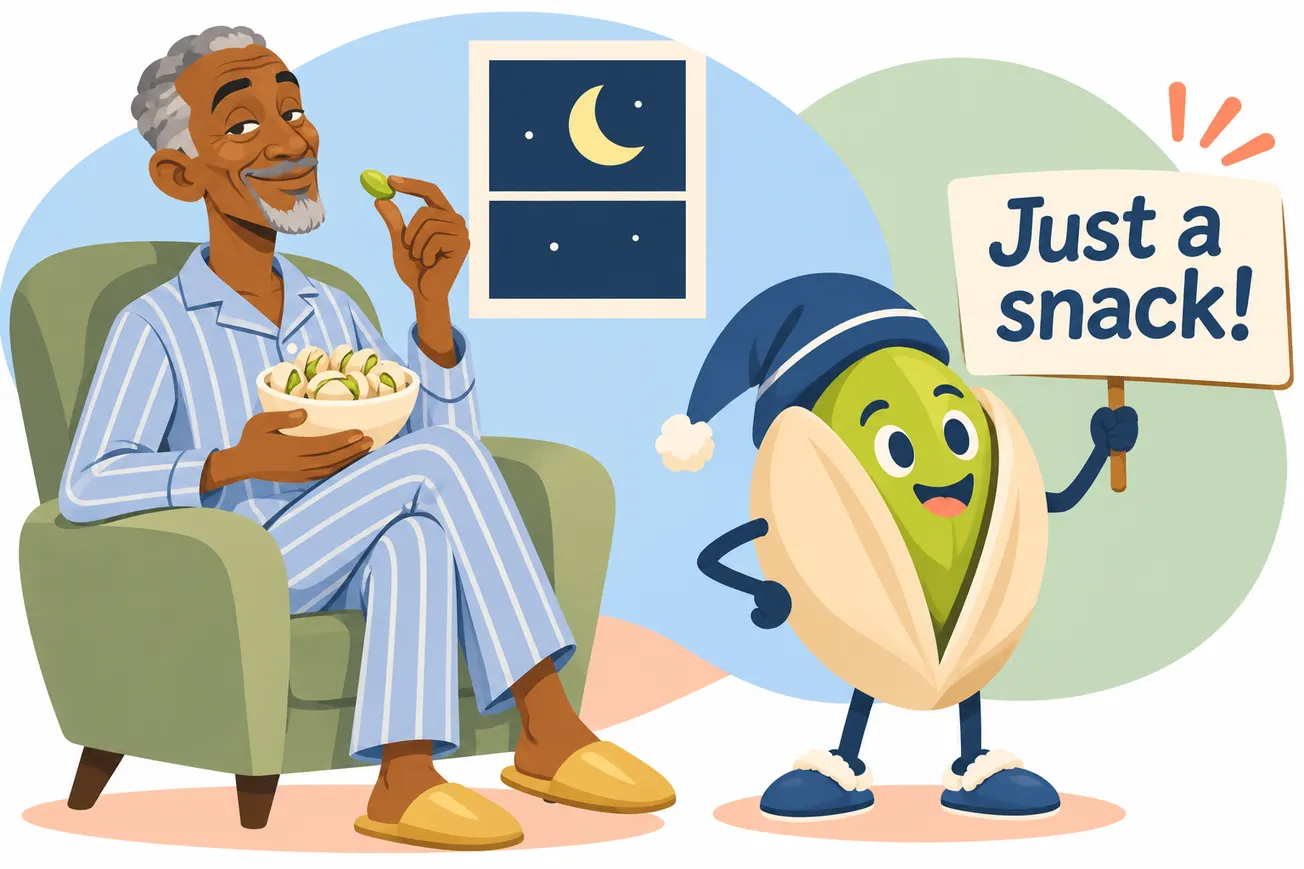
If you've seen the headlines this month, you might be thinking about swapping your nightcap for a bowl of pistachios. A Healthline report on October 19 asked whether a handful before bed could help you sleep, and the idea has been making the rounds ever since.
The short answer: maybe someday. The research behind the buzz is a review of other studies, not a test of pistachios on actual sleepers. That's a big difference, and it's worth knowing before you start counting nuts instead of sheep.
What the Researchers Actually Did
The study is a September 11 review published in Nutrition Research Reviews. Three researchers, led by Columbia University sleep and nutrition scientist Marie-Pierre St-Onge, went through existing research on the nutrients pistachios contain and asked whether, together, they could plausibly help sleep.
On paper, pistachios check a lot of boxes. A one-ounce serving (about 159 calories) contains:
- Tryptophan, about 71 mg. Your body uses this amino acid to make serotonin and then melatonin.
- Vitamin B6, roughly 38% of the daily value. It helps convert tryptophan along that same pathway.
- Magnesium, about 31 mg, or around a tenth of what most adults need daily.
- Fiber and polyphenols, plant compounds that feed gut bacteria, which some research links to sleep regulation.
- Phytomelatonin, the plant version of the sleep hormone.
The researchers came away suggesting that pistachios "could represent a promising" whole-food option, they wrote, but human trials are needed to see whether eating them changes sleep at all.
 Gary P Guthrie
The Fine Print
Once you get past the headline, three things jump out.
Nobody fed anyone pistachios. Most of the supporting evidence comes from studies of single nutrients in supplement form, other foods like tart cherry juice and tomatoes, lab dishes, and rats. There is no trial showing pistachios improve sleep in people.
The amounts don't line up. A 2021 analysis found tryptophan supplements may help people stay asleep, but mostly at doses of a gram or more a day. An ounce of pistachios delivers about 71 mg, or roughly one-fourteenth of that. Melatonin is even fuzzier. The review cites one lab measurement of about 18.7 micrograms per serving of American pistachios and another estimate closer to 0.074 micrograms. That's a 250-fold gap. For comparison, a typical 1 mg melatonin tablet holds 1,000 micrograms.
The pistachio industry helped pay for it. The paper lists funding in part from American Pistachio Growers, along with the National Institutes of Health, and St-Onge sits on that trade group's advisory board. She's a respected sleep researcher, and the review is upfront about it. Still, when the people who sell a food help fund research suggesting it's good for you, it's fair to keep your enthusiasm in check until independent trials come in.
To her credit, St-Onge told Healthline that a clinical trial is the next step and that her team is working on one.
 Smart Senior Daily Staff
So what's a sensible evening snack?
“There aren’t any studies showing that people who eat pistachios before bed really fall asleep faster or sleep better,” says Scott Braverman, MSN, FNP-C, a nurse practitioner with Mochi Health.
“The amount of melatonin you’d get from a handful is much smaller than what’s in a typical supplement, and we don’t know how much of it the body absorbs from food.”
Still, he adds, their magnesium, B6, protein, and healthy fats earn pistachios “a place in a healthy diet.”
None of this makes pistachios a bad choice. They're a solid snack with protein, fiber, and healthy fats. Just treat them as food, not medicine.
A few practical pointers if you want to try them:
- Keep it to a small handful. About an ounce of shelled pistachios is a reasonable portion. At roughly 160 calories, a second and third handful add up fast.
- Check the salt. Many pistachios are sold salted. If you're watching your blood pressure, look for "unsalted" or "lightly salted" on the label.
- Eat light, and not too late. A small snack is fine. A big meal close to bedtime can work against you, especially with reflux.
- Allergic to tree nuts? Skip them. Eggs, dairy, fish, beans, oats and tofu also supply tryptophan.
- Mind the other usual suspects. Afternoon coffee and an evening drink are more likely culprits for restless nights than a missing nut.
“If pistachios help anyone sleep, the likely reason is that they replaced the nightcap,” says Nick Peplow, founder of the medical travel service Thailand Care.
When it's not about the snack. Sleep often gets harder after 50, and the causes are usually bigger than diet. Sleep apnea, frequent nighttime bathroom trips, pain, and medication side effects are all common. If you're regularly lying awake or waking up tired, talk to your doctor. Cognitive behavioral therapy for insomnia (CBT-I) is the first-line treatment medical groups recommend, and it has far more evidence behind it than any food.
Sources:
- Mixon A, Pérez-Jiménez J, St-Onge M-P. Exploring the role of pistachio nutrients and bioactive components in sleep health: a narrative review. Nutrition Research Reviews, published online September 11, 2026. Funding and competing-interest statements included.
- Andrea Rice, A Handful of Pistachios May Help You Sleep Better, Review Says. Healthline, October 19, 2026.