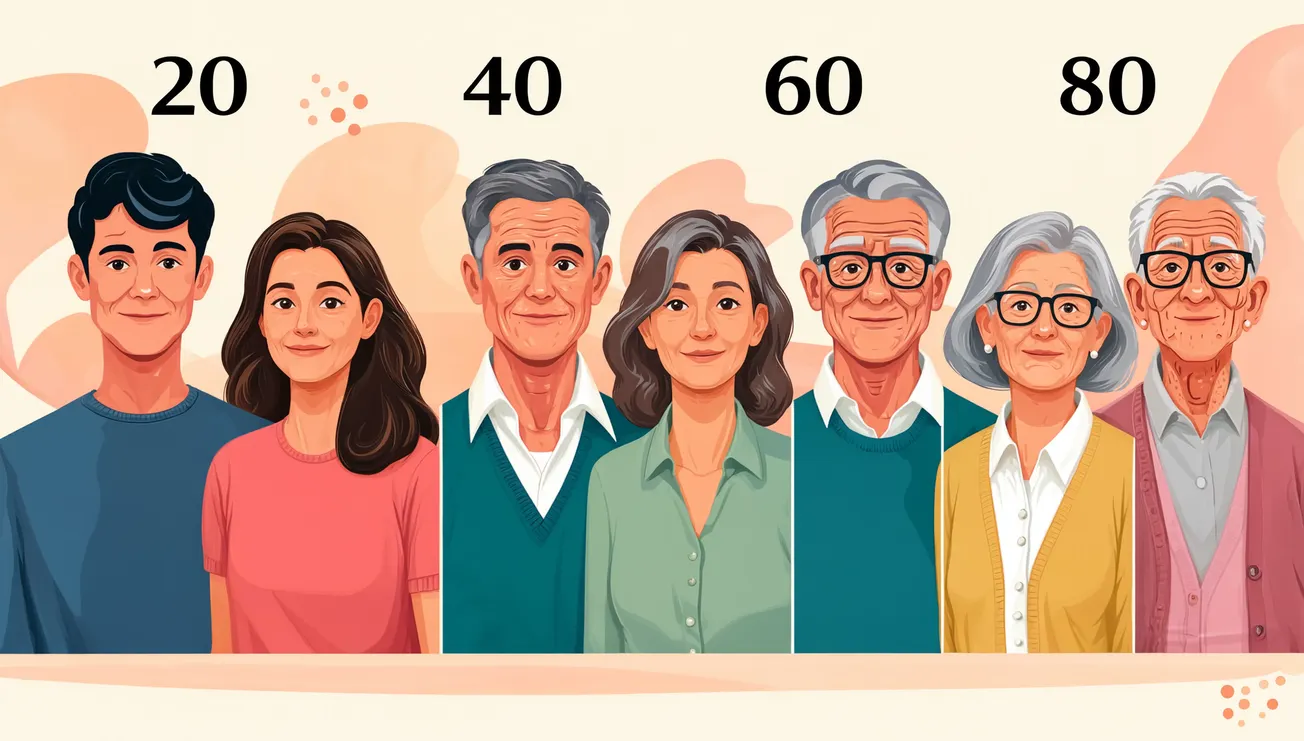
Your chronological age is simply how many birthdays you've had. Your biological age reflects how well your body is actually functioning at the cellular level. Unlike the first number, the second one (biological) is something you can influence.
Over the past several months, a steady stream of studies has identified new factors that appear to slow biological aging, some involving medications and others involving everyday choices. Here are seven of the most compelling.
Here's an all-in-one graphic version if you're looking for a quick read...
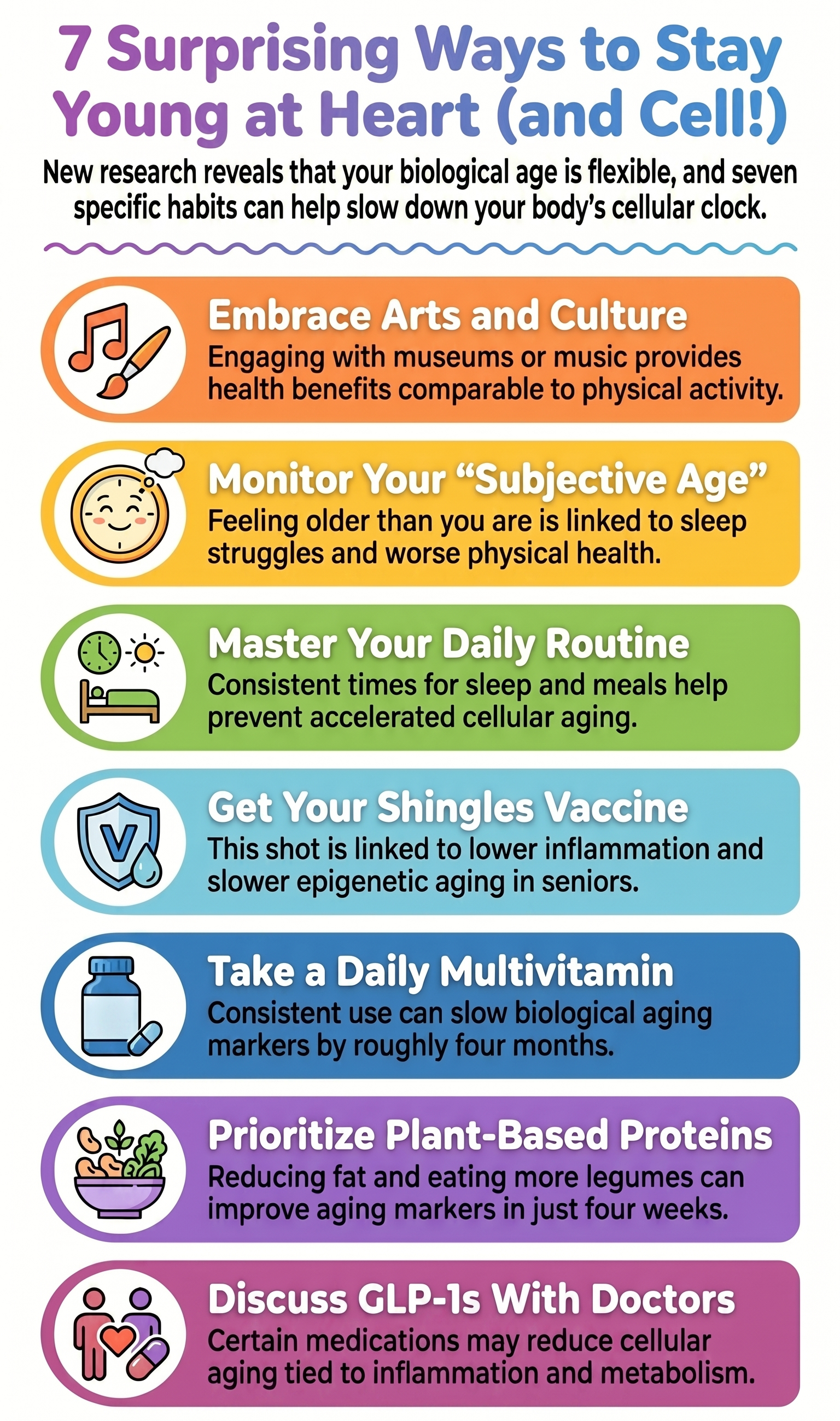
1️⃣ Go to a museum. Or a concert. Or pick up a paintbrush.
A May 2026 study from University College London, published in Innovation in Aging, found that people who regularly engaged in arts and cultural activities — visiting museums, galleries, theaters, and concerts, or creating art through painting, singing, or dancing — showed measurable signs of slower biological aging.
Researchers analyzed blood samples from more than 3,500 adults using epigenetic clocks, which estimate biological age by tracking chemical changes to DNA. The effect held for both "doers" and those who simply attended. One geneticist called the results "comparable to physical activity" — a remarkable benchmark.
2️⃣ Pay attention to how old you feel — especially if sleep is a struggle.
A study presented at SLEEP 2026 found that adults who feel older than their actual age are significantly more likely to struggle with insomnia, irregular sleep, and daytime fatigue and the link held even after controlling for depression and anxiety.
Researcher Joseph Dzierzewski of the National Sleep Foundation said subjective age appears to be a meaningful health signal on its own. If you regularly wake unrefreshed or feel dragged down during the day, it's worth raising with your doctor.
 Gary P Guthrie
3️⃣ Build a consistent daily routine and stick to it.
Research from the Johns Hopkins Bloomberg School of Public Health found that people with consistent times for sleep, activity, and rest showed slower biological aging than those with fragmented or unpredictable schedules.
Disrupting the body's internal clock repeatedly appears to accelerate cellular aging. The prescription is simple if not always easy: regular bedtimes, consistent mealtimes, and predictable movement patterns throughout the day all appear to work in your favor.
4️⃣ Get your shingles vaccine
A January 2026 USC study analyzing data from nearly 3,900 Americans age 70 and older found that those who'd received the shingles vaccine showed lower inflammation levels, slower epigenetic aging, and better overall biological health markers across seven different indicators.
The mechanism likely involves the vaccine's effect on chronic low-grade inflammation, a well-established driver of age-related disease. The CDC recommends the shingles vaccine for adults 50 and older — if you've been putting it off, this is a good reason to stop.
5️⃣ A daily multivitamin may be doing more than you think.
A large clinical trial led by researchers at Harvard Medical School and Mass General Brigham, published in March 2026 in Nature Medicine, found that adults who took a daily multivitamin for two years showed slower biological aging across five DNA-based markers, approximately the equivalent of roughly four months less aging.
Those already aging faster than their chronological age benefited most. Not a magic bullet, but for something most people already take or could easily add, the potential upside looks real.
 Smart Senior Daily Staff
7️⃣ Shift toward less fat and more plant protein — even for a month.
A University of Sydney study published in May 2026 found that older adults who reduced fat intake and moved toward more plant-based protein showed measurable improvements in biological aging markers in as little as four weeks.
The strongest results came from a lower-fat, higher-carbohydrate approach; those who stayed closest to their usual diet saw almost no change. Four weeks is a realistic window to run your own experiment.
7️⃣ Ask your doctor about GLP-1 medications.
A June 2026 study found that semaglutide (the active ingredient in Ozempic and Wegovy) may slow biological aging by reducing cellular aging markers tied to inflammation and metabolic function.
GLP-1 medications require a prescription, carry side effects, and aren't appropriate for everyone. But for people who are already candidates for this class of drugs, the emerging anti-aging data adds another dimension worth discussing with a physician.
The bigger picture
Most of these studies are observational — they identify associations, not proven cause and effect. But the evidence points in a consistent direction: biological aging isn't simply a matter of genetics or fate. The choices we make daily — what we do, how we sleep, what we eat, which preventive care we accept — appear to influence how fast our bodies age at the cellular level. That's worth paying attention to.
Sources:
GLP-1 (semaglutide): UC San Diego press release https://today.ucsd.edu/story/study-popular-glp-1-drug-may-slow-down-biological-aging
Sleep/subjective age: SLEEP 2026 official meeting press release https://www.sleepmeeting.org/feeling-older-than-your-age-linked-to-poorer-sleep-and-worse-daytime-functioning/
Arts and cultural activities: UCL press release (official university source) https://www.ucl.ac.uk/news/2026/may/engaging-arts-linked-slower-pace-ageing
Shingles vaccine: USC Leonard Davis School of Gerontology press release https://gero.usc.edu/2026/01/19/shingles-vaccine-slower-biological-aging/
Multivitamin: ScienceDaily / Mass General Brigham https://www.sciencedaily.com/releases/2026/05/260512202345.htm
Daily rhythms: ScienceAlert / Johns Hopkins https://www.sciencealert.com/your-daily-rhythms-may-help-slow-biological-aging-study-suggests
Diet shift: ScienceDaily / University of Sydney https://www.sciencedaily.com/releases/2026/05/260511213144.htm